>

>

What is an agency CSS?

What is an agency CSS?

An agency CSS is a dedicated Comparison Shopping Service (Google CSS) of an advertising agency. The agency can operate its own price comparison site (CSS) and thus display Google Shopping ads for advertisers. For agencies, having their own agency CSS makes sense in order to achieve better conditions, more control, and strategic advantages over Google Shopping Europe or third-party CSS.
A crane carries a Google CSS center for agencies

What is a Google CSS fundamentally?

A Google CSS is a price comparison site that provides the infrastructure through which Google Shopping ads are displayed. Instead of advertising with Google Shopping Europe, the display is done through a CSS partner, which can save up to 20% on click costs, as no margin from Google is charged. 

In addition to CSS third-party providers, agencies also have the option to become their own CSS partner and operate their own price comparison site. This way, they save both the 20% CPC and can design the site to fit their branding. 

What is the difference between Google CSS and agency CSS?

When choosing between Google Shopping Europe, Google's standard CSS, or an agency's own CSS, the following differences arise: 

Google Shopping Europe

Agency CSS

Price comparison site by Google 

Agency's own CSS 

No customization 

Control over the UX and branding of the site
Choice of a custom keyword 

“By Google” under the ads

freely chosen keyword under the ads (Brand Awareness Boost)  

Higher CPC due to Google's margin 

20% CPC savings 

No prioritization of products 

Prioritization of own customers or their products 

You can find out more about the various CSS options and which one is best for you here: Google Shopping Europe or own agency CSS - What are the differences?

How does an agency CSS work in practice?

Agencies that want to become CSS partners themselves can do so most easily with white label solutions, such as the one provided by Label Up. Label Up handles the Google certification and provides the technical infrastructure. Additionally, agencies can design their own CSS, including keywords, with the white label solution in a way that fits their branding. 

The agency itself manages the CSS, ties customers in, and thus activates shopping or PMAX campaigns for them. No operational changes occur for their e-commerce customers; the performance lever lies in the background. 

Why do agencies use their own CSS? 

  1. Scalability: An agency CSS allows managing an unlimited number of customers under a central structure.

  2. Competitive advantage: Agencies with their own CSS achieve more clicks at lower costs, as they receive up to 20% CPC savings. In addition, their white label CSS is customized to the agency's branding, and they place their own keyword under the ads. The click on the keyword redirects free of charge to the price comparison site, which can then be redirected directly to a shop. 

  3. More control over data & setups: Unlike Google Shopping Europe or third-party providers, an agency's own CSS provides better transparency and flexible control, which contributes to a long-term stable performance. With its own branding and prioritization of its own customers' products, it brings a scalable competitive advantage 

Here you will find a prime example of the agency Strive, which was able to gain real advantages from switching to its own agency CSS: Strive strived - with CSS
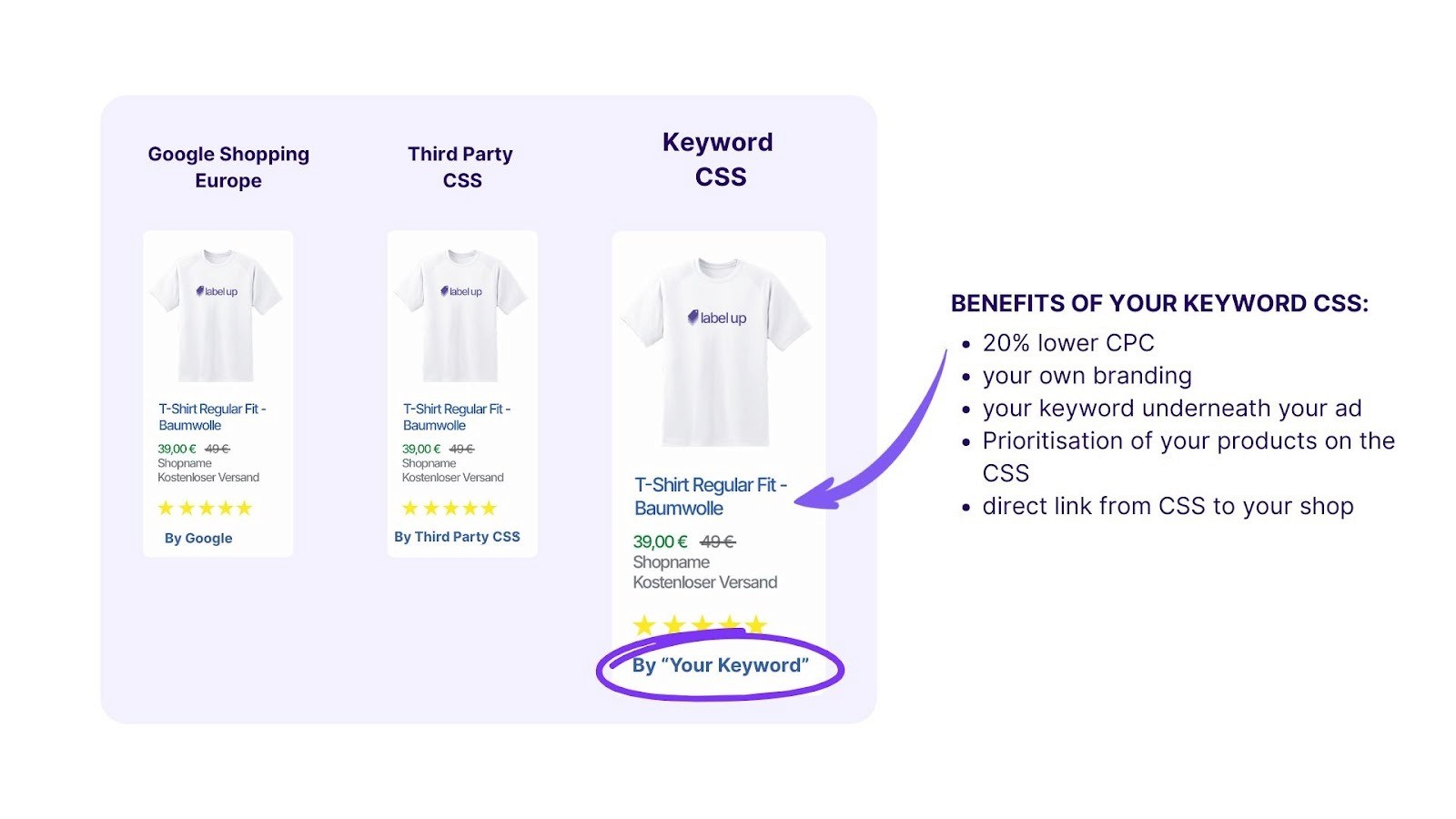
Benefits of your own ageny Google CSS

When does an agency CSS make sense?

An agency CSS is particularly useful for:

  • Agencies with multiple shopping customers

  • Customers with high Google Shopping spend

  • Agencies focused on performance scaling

  • Setups where PMAX & Shopping are to be strategically optimized

  • Cost savings through 20% CPC advantage and free clicks on the keyword 

What role does an agency CSS play in Performance Max?

Google Shopping ads are an essential part of the all-rounder Google PMAX, as a PMAX campaign is only as good as the setup behind it. With the up to 20% CPC advantage in the CSS model, PMAX can bid more efficiently with the same budget, buy more clicks, and generate learning signals faster. Particularly in shopping-heavy PMAX setups, this cost advantage has an immediate impact on scalability.

This is particularly relevant for agencies, as PMAX itself is highly automated and offers only a few external levers. An agency CSS is one of the few structural optimizations outside the PMAX black box and creates a measurable efficiency and competitive advantage, provided that feed quality and campaign setup are correct.

Conclusion: Is a Google CSS worthwhile for agencies? 

Yes, the Google CSS partnership for agencies is a no-brainer when managing large ad budgets in e-commerce. With their own price comparison site from Label Up, it is possible to provide the technical infrastructure for Google Shopping Ads for customers themselves. As a Google CSS partner, agencies stand out massively from the competition, benefit from a cost advantage, rely on their own branding, and position themselves as experts in the Google Shopping cosmos. 


This guide was created by the e-commerce experts from Label Up. We support agencies and shops in operating their own price comparison site (Google CSS) and in optimizing their Google Shopping campaigns data-driven. 

About

Label Up is a tech provider from Vienna that helps agencies and shops achieve better results with its own Google Shopping CSS and smart label-based optimization.

Featured Posts

8 Apr 2026

/

3

Min reading time

In the competitive e-commerce environment, a simple product image is often no longer enough to capture users’ attention. Google Shopping Lifestyle Images offer the solution here: with this new feature, you can present products in a natural, emotional setting. This not only increases the click-through rate, but also provides the AI behind PMAX with valuable data to serve your ads more relevantly. That way, you can use lifestyle images without risking policy violations.

Take your shopping ads to the next level.

Questions about the Google CSS partnership? Or would you like to learn more about optimisation with smart labels? Regardless, you can discuss with one of our experts. In a short online call, we can show you our solution and discuss your questions. All without sales talk.

Filip

Co-Founder & Partnerships

Take your shopping ads to the next level.

Questions about the Google CSS partnership? Or would you like to learn more about optimisation with smart labels? Regardless, you can discuss with one of our experts. In a short online call, we can show you our solution and discuss your questions. All without sales talk.

Filip

Co-Founder & Partnerships

Take your shopping ads to the next level.

Questions about the Google CSS partnership? Or would you like to learn more about optimisation with smart labels? Regardless, you can discuss with one of our experts. In a short online call, we can show you our solution and discuss your questions. All without sales talk.

Filip

Co-Founder & Partnerships

Read more:

8 Apr 2026

/

3

Min reading time

In the competitive e-commerce environment, a simple product image is often no longer enough to capture users’ attention. Google Shopping Lifestyle Images offer the solution here: with this new feature, you can present products in a natural, emotional setting. This not only increases the click-through rate, but also provides the AI behind PMAX with valuable data to serve your ads more relevantly. That way, you can use lifestyle images without risking policy violations.

31 Mar 2026

/

3

Min reading time

In 2026, Google Shopping will launch in Luxembourg as part of the Bundle-1 expansion into 15 EMEA markets. For retailers in the Grand Duchy, this is an opportunity to visually position products at the top of search. Learn how to leverage linguistic diversity (DE, FR, EN) and secure a structural advantage of 20% lower CPCs and exclusive branding with your own keyword CSS from Label Up, before the competition occupies the market.

31 Mar 2026

/

3

Min reading time

Google Shopping Ads are coming to Latvia in 2026! As part of the "Bundle 2" rollout, this launch gives merchants the opportunity to be visible with visual ads at the top of search results just in time for the Christmas shopping season. Learn how to overcome technical challenges like language localization and secure a structural advantage of 20% lower CPCs compared to the competition with your own keyword CSS from Label Up.

31 Mar 2026

/

3

Min reading time

E-commerce in Croatia is on the verge of transformation: Google is officially rolling out Shopping Ads in 15 new EMEA markets in 2026. The launch for the Croatian market is scheduled for Q4 2026. This provides businesses with the opportunity to place products as Google Shopping Ads just in time for the Christmas season of 2026. To successfully leverage this launch as a first mover, a strategic shift from traditional text ads to a product data-driven strategy is necessary.

31 Mar 2026

/

3

Min reading time

In November 2026, Google Shopping will launch in Lithuania as part of an expansion into 15 EMEA markets. In e-commerce, this is the opportunity to place products visually at the top of search results. To secure maximum margins, choosing the right CSS infrastructure is crucial. Find out how to leverage the first-mover advantage and outpace the competition with a custom keyword CSS from Label Up, achieving 20% lower CPCs and strong branding right from launch.

30 Mar 2026

/

3

Min reading time

E-commerce in Cyprus is at a turning point: In July 2026, Google Shopping Ads will officially roll out. This time window offers local retailers and agencies the rare opportunity to benefit as "first movers" from low CPCs and high visual presence. Find out here what technical requirements are necessary for the feed launch, how to navigate the 20% CSS margin, and why having your own keyword CSS provides the crucial branding advantage in Nicosia and beyond.

8 Apr 2026

/

3

Min reading time

In the competitive e-commerce environment, a simple product image is often no longer enough to capture users’ attention. Google Shopping Lifestyle Images offer the solution here: with this new feature, you can present products in a natural, emotional setting. This not only increases the click-through rate, but also provides the AI behind PMAX with valuable data to serve your ads more relevantly. That way, you can use lifestyle images without risking policy violations.

31 Mar 2026

/

3

Min reading time

In 2026, Google Shopping will launch in Luxembourg as part of the Bundle-1 expansion into 15 EMEA markets. For retailers in the Grand Duchy, this is an opportunity to visually position products at the top of search. Learn how to leverage linguistic diversity (DE, FR, EN) and secure a structural advantage of 20% lower CPCs and exclusive branding with your own keyword CSS from Label Up, before the competition occupies the market.

31 Mar 2026

/

3

Min reading time

Google Shopping Ads are coming to Latvia in 2026! As part of the "Bundle 2" rollout, this launch gives merchants the opportunity to be visible with visual ads at the top of search results just in time for the Christmas shopping season. Learn how to overcome technical challenges like language localization and secure a structural advantage of 20% lower CPCs compared to the competition with your own keyword CSS from Label Up.

31 Mar 2026

/

3

Min reading time

E-commerce in Croatia is on the verge of transformation: Google is officially rolling out Shopping Ads in 15 new EMEA markets in 2026. The launch for the Croatian market is scheduled for Q4 2026. This provides businesses with the opportunity to place products as Google Shopping Ads just in time for the Christmas season of 2026. To successfully leverage this launch as a first mover, a strategic shift from traditional text ads to a product data-driven strategy is necessary.