>
>
Google Shopping has not disappeared. The space now belongs to comparison shopping services.
Google Shopping has not disappeared. The space now belongs to comparison shopping services.
Google Shopping: What the new CSS boxes mean and what you should do now.

Update, 31 September 2026: Google confirms DMA reference, feature live Europe-wide
A Google employee has confirmed in a comment on one of our LinkedIn posts that the change stems from the EU Commission's decision. An official announcement from Google is still pending.
According to our observations, the new section is now live in all European Economic Area countries we tested, no longer just in Germany, France, Spain and Italy.
The unit is referred to as an Aggregation Unit: up to eight comparison services with up to eight products each, meaning up to 64 products right at the top of the search results page. By default, one of these boxes is expanded.
The reporting over the last few days has been: Google Shopping's free listings have disappeared from EU search. This describes the change incorrectly, and the difference has significant consequences for merchants.
What has disappeared are the embedded product grids containing offers that linked directly to the shop. In their place is a section where each Comparison Shopping Service gets its own expandable box with its own logo and its own inventory. Google's own comparison service is just one box among several within this.
The crucial point: what is displayed in these boxes are product pages of comparison services, not product listings. A click leads to a comparison page with several offers, not directly to the shop. The space has therefore been taken over, but the free product listings have not been replaced. They have been replaced by something else.
The Essentials in 30 Seconds
The product grids are gone, the space is not. It now shows an accordion with one box per Comparison Shopping Service, each with its own branding and inventory.
The boxes contain product pages, not product listings. The click leads to a comparison page with several offers, not directly to the shop. The direct organic route from the search result to the shop is therefore gone for this space.
It is an organic space, not an ad space. It is not marked as sponsored. Paid Shopping ads continue to exist alongside it unchanged.
It is an SEO space. Comparison services with genuine, search-engine-optimised product pages are displayed. Those who merely mirror feed products without independent pages do not appear there. Consequently, established price comparison sites or subpages optimised for a niche dominate. With a Label Up CSS, you can also appear here and collect clicks.
This is not a surprise. The same structure has been running in the travel sector for some time, and comparable drafts were already present in Commission tests in 2024. The only new thing is that it is now live in product search.
Switching to a large comparison service won't bring you visibility there. Why that is, is explained below. What does work instead is also covered.
According to internal information from Google, the new layout is set to be rolled out across the entire EEA in September.
What happens on the search results page
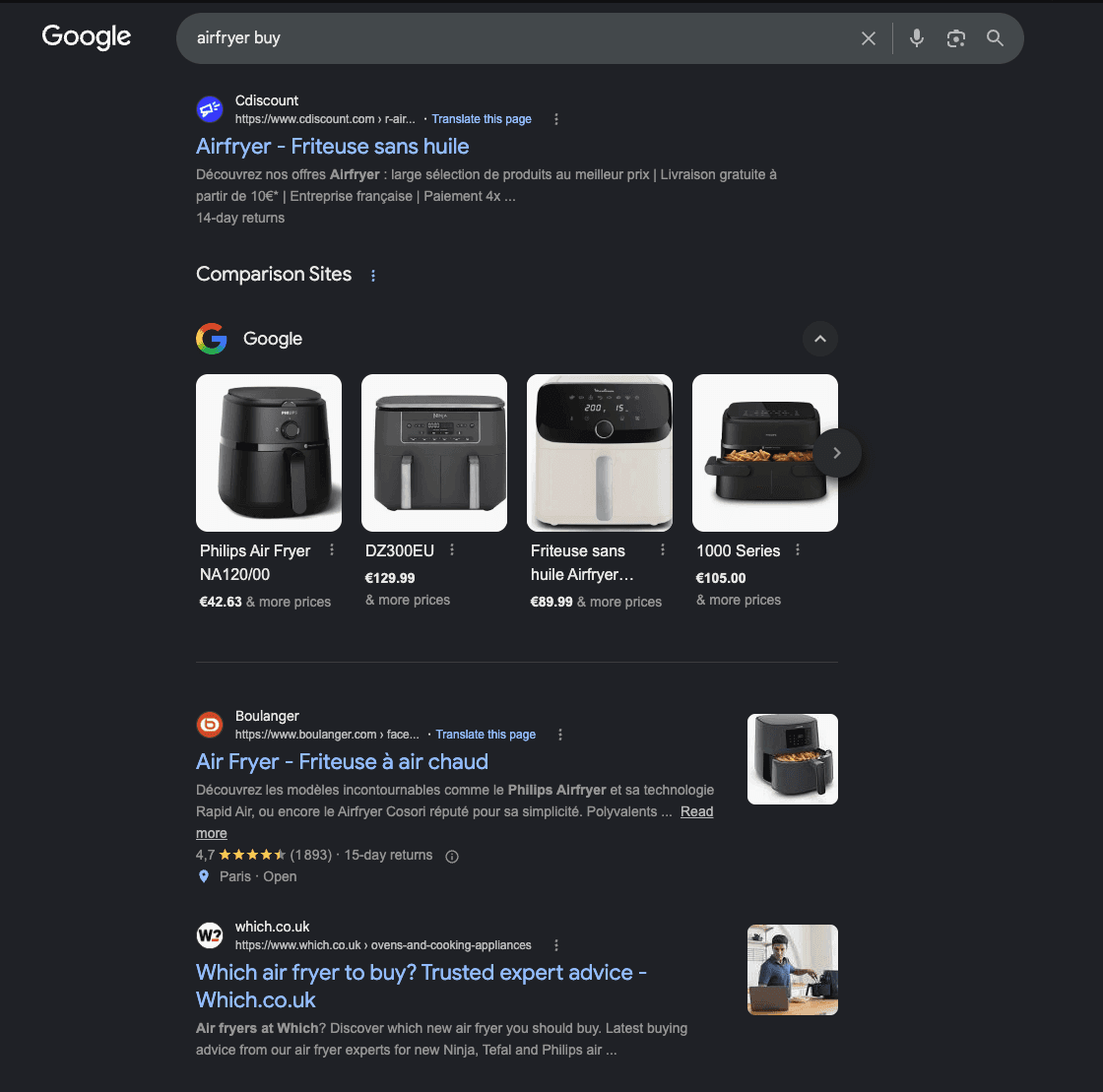
Under the "Comparison Sites" section, each Comparison Shopping Service gets its own expandable box with its logo and name. Here, Google's box is expanded, showing four swipeable cards, each with an image, product name, price, and the note "& more prices" — indicating that a list of offers lies behind it, rather than a single merchant offer. Above and below the section are regular organic search results, in this case Cdiscount, Boulanger and which.co.uk.
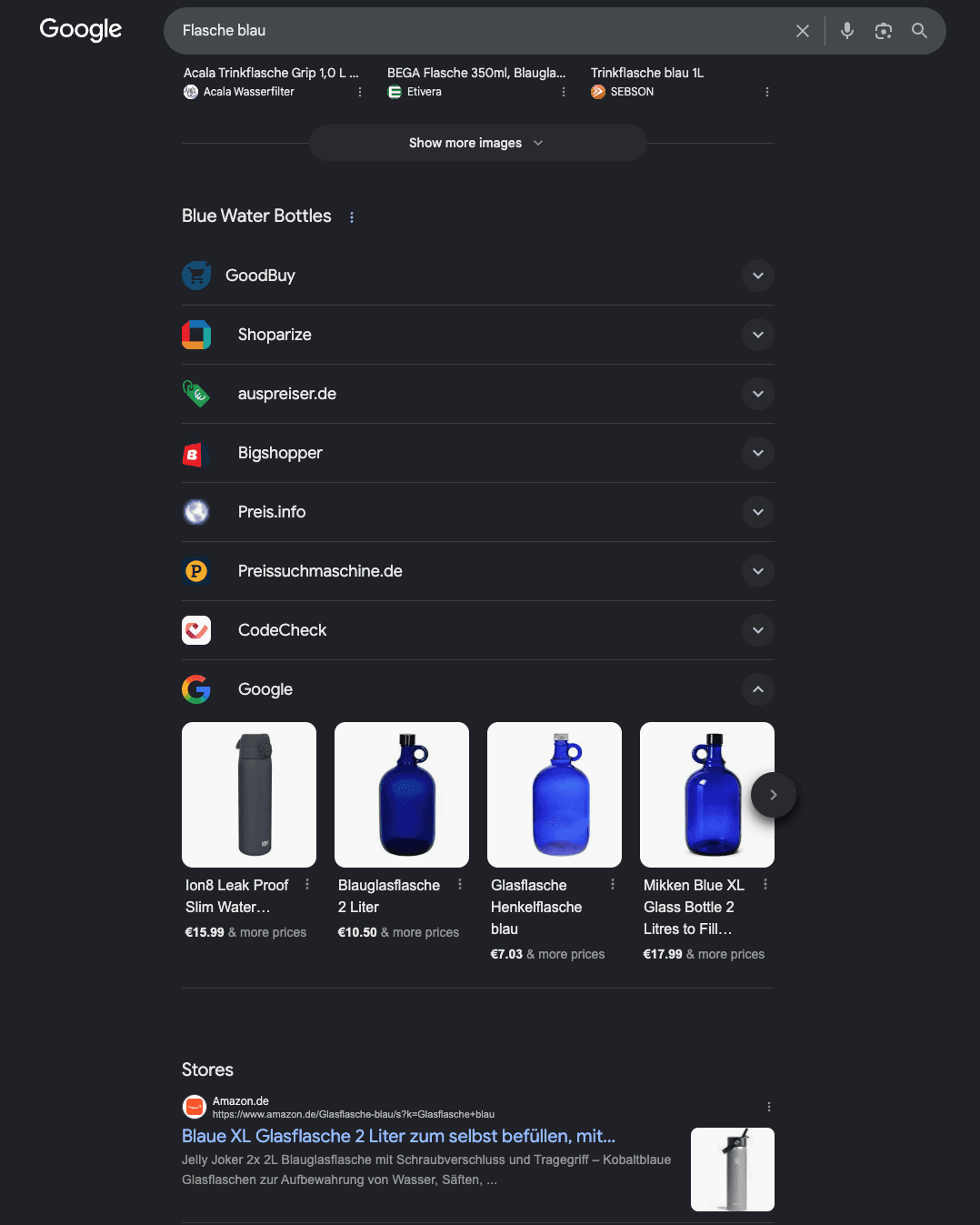
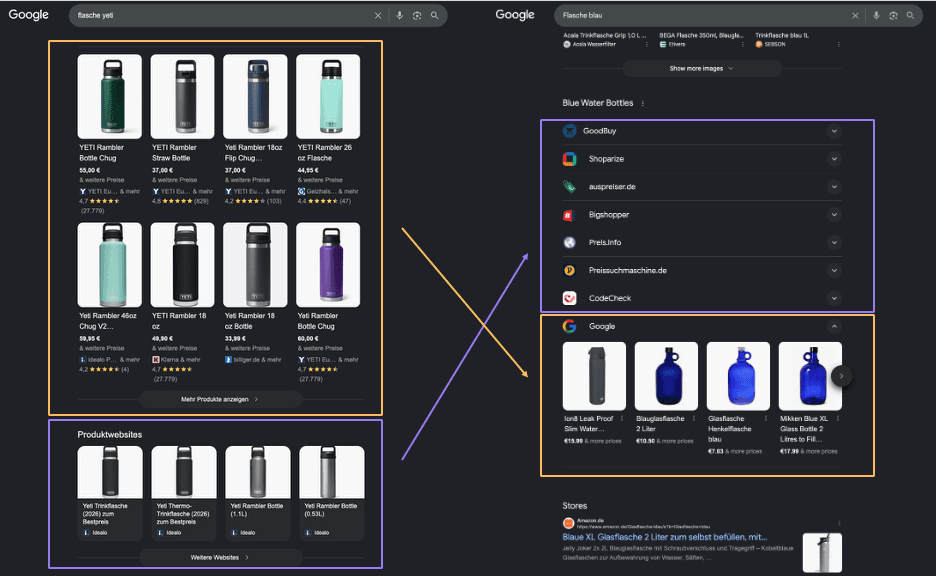
Three differences from the first view. Firstly, the section does not bear a label like "Comparison Sites", but a generated product title, here "Blue Water Bottles". Secondly, Google is not expanded, but rather the comparison service GoodBuy; below it are the collapsed boxes of Shoparize and auspreiser.de, with further services found behind "More products". Thirdly, beneath the accordion is a separate section called "Stores" with organic merchant results including thumbnail and description, here Amazon.de and Haus-Hobby-Garten.
Three observations on this:
The top box does not automatically belong to Google. In the second view, GoodBuy is expanded, and Google Shopping does not appear visible there. The space is therefore genuinely open and not just renamed.
Merchants get their own section in one variation. The "Stores" block shows shops as independent organic results with a thumbnail and description, independent of any comparison service. This is the space where a shop is visible without any detours. The links do not come from product data in the Merchant Centre, but are, based on our observations, the top organic results for shops. A shop only gets one link.
Added to this is the navigation: the Shopping tab has disappeared from the tab bar and is not to be found under "More" either. Anyone wanting to access the Google Shopping overview must open "More products" in the results list, select Google there, and then click "View more".
What we see in initial performance data
In the first few days after the transition, the Merchant Centres we manage show a decline in organic impressions and clicks in the region of a good 20 per cent, with a sharper decline in clicks than in impressions.
We won't say more at this point, and that is a conscious decision. A comparison window of just a few days is dominated by day-of-the-week effects and individual large accounts. A breakdown by country or product category on this basis would be pseudo-accuracy. We will publish the reliable analysis as soon as a window of at least four weeks is available, and append it here.
What can already be said: impressions do not drop to zero. This is to be expected because Merchant Centre organic reach covers several areas, including product knowledge panels and image search, and because offers via comparison services still appear in the new space, just packaged differently. Anyone wanting to check how much their own account is affected can find this in the Merchant Centre and in the merchant listings report in Search Console under Performance and Search Appearance.
The fact that clicks are falling faster than impressions is plausible: an embedded product grid attracts more clicks than an accordion where the user first has to expand a service.
The most important point: these are product pages, not product listings
This is the difference that is completely missing from the reporting and which dictates what should be done now.
What was in the space before: Product listings from the Merchant Centre. One offer, one merchant, a click straight to the shop.
What is in the space now: Product pages from comparison services. One page, several offers, a click to an intermediate page from which the user clicks further.
For a merchant, this means: visibility isn't gone, but the direct route is. The organic click that previously landed in the shop now lands on a comparison page first. A coalition of European comparison services raised precisely this point in an open letter to the European Commission on 8 September 2026, just a few days before the transition: forced intermediate clicks create friction, increase costs for merchants, and harm user satisfaction. The letter demanded, among other things, that comparison services that want to lead users directly to the merchant's site should be allowed to do so.
Why established price comparison sites dominate there
The space is organic. This means: it is filled based on the criteria Google uses to evaluate organic results, not on feed configuration.
Therefore, comparison services displayed are those that run genuine, search-engine-optimised product pages: pages with independent content, clean structure, working indexing, and multiple offers per product. A comparison service that merely mirrors feed products without providing independent, indexable pages for them does not appear in this space.
This explains why names like idealo or billiger.de appear there, and not just any comparison service from the CSS programme. It is not a privilege, but a consequence of these providers running organically ranking product pages for years.
Why switching to a large comparison service won't help you there
This is the misconception currently driving most poor decisions: "Idealo is visible there, so I'll join a large comparison service and be visible too."
That does not work, for two reasons.
Firstly, these are two different systems. Price comparison portals like idealo or billiger.de do not populate their product pages from the Google Merchant Centre. They have their own merchant relationships, feeds, and billing models, usually via affiliate programmes or direct contracts. Being listed there is a separate business decision with separate integration and separate costs. There is no Google setting to achieve this, and connecting a Merchant Centre to a Comparison Shopping Service does not trigger it.
Secondly, the visibility there is not yours. If you as a merchant appear on a price comparison site's product page, their page ranks, not yours. You are just one of several offers on a third-party site. This can make commercial sense, but it does not replace the free Google Shopping listings. The fact that the new space occupies the same spot on the search results page that your product listings had before does not make it a replacement.
And what a Comparison Shopping Service continues to do remains unchanged. Paid Shopping ads run through a CSS, and you will continue to be represented in the Google Shopping tab, if and where it appears. The change has not altered this. Anyone switching their CSS because of the new space is solving a problem that a CSS switch does not address, risking setup disruptions in a channel that is currently working.
What is actually possible in this space
There is a way to appear in the new space with your own page, and it is concrete, but subject to one condition.
Anyone running their own Comparison Shopping Service can set up their own product pages for it and deliver them optimised for search engines. Through Label Up, you can run your own branded CSS with such product pages. This makes it possible to appear in this space with your own page alongside Google Shopping listings and established price comparison sites.
Realistically, this is not viable across the board, but rather where competition for organic visibility is lower: with niche products and with brand and model searches, i.e., queries for which large portals do not have a strong page or where there are few offers.
The technical condition: a product page must function as a comparison page, meaning it must be able to show at least two offers. A page with a single offer is not a price comparison. For exclusive products, this can be resolved by displaying offers from other merchants for the same product, matched via GTIN, including marketplace listings. Anyone selling exclusively products without GTINs and without any secondary sellers cannot use this space with their own product page.
This is not an alternative to the discontinued product listings. It is an additional, self-controlled space, the success of which depends on SEO and not on a configuration. We consider this an approach that works with the right product selection, rather than a universal solution.
And what belongs to you without any detour
Regardless of everything mentioned above: the "Stores" block in one of the layout variations shows shops as independent organic results. This space relies on classic product and category page optimisation and is not tied to any comparison service. For merchants, this is visibility that belongs to no one else, and it has gained relative importance following the change.
Why this was foreseeable
The space seems new, but it isn't. It is the application of a pattern that has been running elsewhere for a long time to product search.
In the travel sector, this structure has existed for a while. There, Google separates a space for comparison and booking portals from one for direct providers. On 8 September 2026, Google further restructured this area in the European Economic Area, removing live prices and date filters from its own provider space and shutting down the unit for holiday rentals.
Drafts in this direction were already available in 2024. As part of the tests conducted by the European Commission at the time regarding implementation, mockups of layouts circulated that structurally match the state that has now gone live. Anyone involved in these processes has known the direction of travel for two years.
What is new is not the concept, but the timing and the fact that it went live without announcement.
Why it had to look exactly like this
The basis is the European Commission's implementing decision C(2026) 5358 final of 23 July 2026, case DMA.100193. The Commission found that Alphabet had been violating Article 6(5) of the Digital Markets Act since 7 March 2024, because Google Search treats its own services more favourably in placement than comparable third-party services. The fine is 460 million euros, with a deadline of 60 calendar days to remedy the situation. It therefore ends around 21 September 2026.
Recital 713 mentions two ends of a spectrum. Alphabet can either extend the prominence of its own services to comparable third-party services, or completely remove its own prominence. For travel and organic product search, Google chose the former for both: opening up instead of deleting.
Recitals 214, 219, 220, 221 and 222 define what opening up means. Five times in identical wording, the Commission demands that a third-party comparison service must have its own box, embedded in the search results page, visible immediately after entering the search query, displaying multiple offers from its own inventory that the user can compare directly on the search results page. This is exactly what can be seen in the screenshots.
Recital 253 explains the removal of the Shopping tab. The Commission objected to Google's comparison service having a reserved page via the products tab that exclusively expanded its own inventory, while no third-party provider received such a tab. With over a thousand approved comparison services in the European Economic Area, a tab per service was not feasible, so the tab was dropped.
Recitals 78 and 214 block the simple way out. Prominence that depends on requirements that do not apply to Google itself does not constitute equal treatment under the decision. Anyone who must become a business partner of Alphabet to become visible becomes a supplier to Google's own service. Simply giving third-party providers a larger share within a Google space was therefore ruled out.
The line of reasoning is older than the DMA. Footnote 43 of the decision refers to the General Court of the European Union's judgment of 10 November 2021 in T-612/17, upheld by the European Court of Justice on 10 September 2024 in C-48/22 P. This states that participation in Shopping Units requires competing comparison services to change their business model and become customers of Google's comparison service rather than remaining its competitors. Since 2021, it has been legally established that mere participation in a Google space does not constitute equal treatment. The box structure follows from this.
Who gets the expanded box?
The space has one expanded slot. Everything below it is collapsed, and barely anyone looks at what lies behind "More products". This shifts the critical question from "do I appear" to "in which position".
The decision says nothing on this. It defines the standard for the space, not the mechanism for allocating it. Since the space is organic, the answer likely lies in the organic evaluation of the respective product pages, i.e. relevance, page quality and depth of offer. This is not confirmed.
Legally, the lever for this question lies not in Article 6(5), but in the obligation to provide fair, reasonable, and non-discriminatory access conditions under Article 6(12). The Commission itself refers in recital 89 to the fact that it must take this obligation into account when assessing measures.
We are building an ongoing measurement system for this: a fixed set of transactional search queries across multiple markets, tracking which comparison service gets the top box and how often. We will add results here.
What is still open and actually far more important: the paid space
The decision objects to two spaces, not one.
Space | What it is | Status |
|---|---|---|
Products unit | Organic product space (previously: Google Shopping Free Listings, usually at the bottom of search) | replaced by the CSS accordion |
Product ads unit | Paid Shopping ads (Google Shopping Ads, usually product carousel right at the top of Google Search) | unchanged |
In recitals 114 to 119, the Commission also classifies the paid Shopping unit as a standalone Google comparison service, not purely an ad format. Recital 221 finds that the ability to place ads within this unit does not constitute equal treatment. Recital 260 rejects Alphabet's objection that Google's own comparison service does not get its own space either: the unit itself is that comparison service.
Google has changed nothing in this space so far. This is the observation missing from all the reporting.
Our assessment, clearly marked as such: Since Google has chosen to build rather than delete in both the travel sector and organic product search, we consider an analogous structure in the paid space to be more likely than the status quo remaining unchanged. What it would look like is open. For merchants and agencies, this is the point to watch, because the paid space is currently the only route, aside from text results, leading directly from product search to the shop.
What follows if the Commission deems the measures insufficient is laid out in Article 4 of the operative part of the decision: periodic penalty payments under Article 31(1)(h), running from the end of the deadline, with a cap of 5 per cent of the average daily worldwide turnover. By contrast, the fine of 460 million euros corresponds to a fraction of a per cent of Alphabet's annual turnover.
What to do now
For Shops
First, check if and how heavily you are affected. Compare performance before and after the change using the Merchant Centre and the merchant listings report in Search Console. The impact is account-specific and depends on which spaces your organic reach previously came from.
Create. This does not address the issue because the space is filled organically and price comparison portals do not populate their pages from the Merchant Centre. A CSS switch is a decision about your paid delivery, not organic visibility.
Do not switch Comparison Shopping Services to appear in the new space. This does not address the issue because the space is filled organically and price comparison portals do not populate their pages from the Merchant Centre. A CSS switch is a decision about your paid delivery, not organic visibility.
Evaluate the portals separately and commercially. If you want to appear on idealo, billiger.de and similar portals, that is a separate decision regarding affiliate or direct contracts, with its own integration and costs. Treat it like a channel, not a Google setting.
Strengthen the visibility that belongs solely to you. Product and category page optimisation is relatively more valuable now, because the merchant block is the space where you stand without an intermediary.
Keep an eye on the paid space. It is currently the only route leading directly from product search to the shop. Monitor impression share and cost per click separately; a falling impression share with an unchanged budget looks like a campaign problem but isn't.
For Agencies
Approach the client on this topic proactively. Numbers in the Merchant Centre are falling visibly without any changes to campaigns or feeds. And expect clients to come up with the idea of switching CSS on their own because they see idealo there. This is the conversation you should prepare for.
Check which reports are now incorrect. Any dashboard that aggregates organic listings and ads into a single Shopping metric will show a drop from the time of the transition, which could be misread as a campaign problem.
Separate three things in your advice that are currently being confused: paid delivery via a Comparison Shopping Service, organic visibility on your own pages, and commercial presence on price comparison portals. These are three channels with three different mechanisms and cost structures.
For niche assortments and brand searches, a custom approach is worthwhile. Those running their own Comparison Shopping Service with search-engine-optimised product pages can appear in the new space with their own page, provided at least two offers per product can be displayed. For agencies with portfolios in niches, this is an approach worth testing, not a standard lever.
Frequently Asked Questions
Has Google Shopping disappeared from EU search? No. What has disappeared are the embedded product grids and the Shopping tab. In their place is a section where each Comparison Shopping Service gets its own expandable box. Google Shopping is one of these boxes.
Are the free product listings gone? Product listings that linked directly to the shop no longer appear in this space. What is displayed there now are product pages of comparison services with multiple offers. The space has been taken over, but not by an equivalent replacement. Organic reach via product knowledge panels, image search, and in one layout variation, a separate merchant block, remains.
Is the new space paid? No. It is not marked as sponsored and replaces the organic product space. Paid Shopping ads continue to exist alongside it unchanged.
Will I get in there if I switch to a large Comparison Shopping Service? No. The space is filled organically, based on the quality of the product pages of the respective comparison service. And the large price comparison portals do not populate their pages from the Google Merchant Centre, but via their own merchant relationships and affiliate programmes. A CSS switch will not achieve this.
How do I get onto idealo, billiger.de and similar portals then? Through their own onboarding processes, usually via an affiliate programme or direct contract, with separate integration and costs. There is no setting for this in Google products. And if you do appear there, their page ranks, not yours.
Can I appear in this space with my own CSS? Yes. If you are a CSS, you can appear here with your product pages. As a shop or agency, you can create your own CSS with Label Up and generate product pages. The prerequisites are: having your own search-engine-optimised product pages and being able to show at least two offers per product so the page functions as a comparison page. For exclusive products, this can be solved by displaying offers from other merchants for the same product, matched via GTIN. This is realistic primarily for niche products and brand or model searches, not highly competitive generic terms.
Am I still in the Google Shopping tab with a Comparison Shopping Service? Yes. The change has not altered this, to the extent and where the tab appears. Paid Shopping ads also continue to run through a CSS unchanged.
Who decides which box is expanded at the top? Google's organic criteria. Google refers to standard SEO optimisations here.
Does this only apply in the European Union? The change affects users in the European Economic Area, meaning the 27 EU member states plus Iceland, Liechtenstein, and Norway. What matters is where the search originates, not where the merchant is based. Note: the UK and Switzerland, which previously had CSS product and category pages live, are not included this time.
Is this the final state or a test? We believe the structure is stable. Google confirms that the aggregator/supplier design will be rolled out in the EEA during September 2026. Changes are still possible and A/B tests can be observed. The deadline from the Commission's decision does not end until around 25 September 2026. We assume the EU is satisfied with the new design in its current state and Google will only make minor adjustments.
Are paid Shopping ads also affected? Not so far. However, the Commission's decision objects to them using the same reasoning as for the organic space. Since Google has built twice instead of deleting, we consider a change there likely.
Will the Shopping tab return? A tab exclusively for Google's own inventory would be open to challenge again under recital 253 of the decision. A return in its old form is therefore unlikely.
Where does the click on "& more prices" lead? To the offers overview of the respective comparison service, not directly to a merchant offer. This is the core difference compared to the previous product listings.
Chronology
10 November 2021 The General Court of the European Union rules in T-612/17 that participation in Google's Shopping Units turns competing comparison services into customers rather than competitors.
2024 During Commission tests on DMA implementation, layout drafts circulate that structurally match the state that has now gone live.
10 September 2024 The European Court of Justice upholds the judgment in C-48/22 P.
23 July 2026 The European Commission finds a breach of Article 6(5) DMA and imposes a 460 million euro fine. Deadline to remedy: 60 calendar days.
8 September 2026 A coalition of European comparison services addresses the Commission in an open letter, objecting among other things to forced intermediate clicks.
8 September 2026 Google remodels travel search results in the European Economic Area.
12-14 September 2026 Initial reports and replication on our part: product grids, product carousels, and the Shopping tab no longer appear.
Around 25 September 2026 End of the 60-day deadline.
Methodology and reliability assessment
Observations. Our own checks of the search results page in Germany, France, Spain, and Italy, documented with screenshots across several transactional search queries. We do not claim completeness across all markets, devices, or query types. The description of the space is proven, the statements about its prevalence are not.
Data. The stated decline is based on organic impressions and clicks from the Merchant Centres we manage during the first few days following the transition. With a window of this length, averages are susceptible to day-of-the-week effects and the influence of individual large accounts. We therefore only state a general range and deliberately avoid a breakdown by country, product category, or account size. We will publish a reliable analysis once a window of at least four weeks is available.
What we do not publish. No absolute figures, no click prices, no ad budgets, no revenues, no merchant or account names, no individual account values. Analyses are performed strictly on an aggregated basis. Clients who do not wish to have their data included in future analyses can let us know at any time.
What constitutes interpretation. Marked as such in the text: the assessment that this is a test; the expectation of a change in the paid space; and the assumption that the position of the boxes is determined organically. Everything else is either visible on the screenshots or proven from the Commission's decision.
Sources
Primary Sources
European Commission, Implementing Decision C(2026) 5358 final of 23 July 2026, case DMA.100193, Alphabet, online search engine Google Search, Article 6(5) DMA. Used in text: recitals 75 to 78, 89, 93 to 119, 209 to 260, 707 to 715, and Articles 1 to 4 of the operative part.
General Court of the European Union, judgment of 10 November 2021, T-612/17, particularly recital 351.
European Court of Justice, judgment of 10 September 2024, C-48/22 P.
Open letter from a coalition of European Comparison Shopping Services to the European Commission, dated 8 September 2026, eleven signatories. https://docs.google.com/document/d/10is1bKfw8mO5WFN9HcbfZqZkqx_kTd83zf39qenM_2g/edit?tab=t.0#heading=h.hpygx7yden6l
Reporting
SEO Südwest, Christian Kunz, 13 September 2026. https://www.seo-suedwest.de/10957-google-shopping-von-suchergebnissen-fast-komplett-verschwunden-teil-der-anpassung-in-eu.html
Reuters, statement from a Google representative on search quality in Europe, September 2026. https://www.reuters.com/world/google-warns-lower-quality-it-revamps-europe-search-results-avoid-eu-fines-2026-09-08/
Our own collection
Label Up SERP observations and Merchant Centre metrics, as of 14 September 2026
About

Label Up is a tech provider from Vienna that helps agencies and shops achieve better results with its own Google Shopping CSS and smart label-based optimization.
Other topics