>
>
"By we love wool": How Filati stands out from the shopping carousel with their own keyword CSS
"By we love wool": How Filati stands out from the shopping carousel with their own keyword CSS
A niche shop, a passionate community, and the question of whether a wool merchant, of all things, needs their own CSS. The answer: this is precisely where it makes sense.

Anyone who buys wool online rarely just buys wool. Colours are compared, lengths checked, projects planned over weeks, and brands have a face. Filati moves in exactly this world: the specialist for Lana Grossa yarns, on the market for almost three decades, family-run, with tens of thousands of loyal customers. A community that recognises quality and remains loyal to shops they trust.
And yet Filati looked like everyone else in the Google Shopping carousel. Same tiles, same layout, and the name of a third-party CSS provider under the ads. For a shop whose entire strength lies in its niche and its brand, this is wasted space.
Briefly explained: What is a CSS and what makes a Keyword CSS different?
Since the EU antitrust decision against Google, Shopping ads can be placed not only via Google itself, but also via independent Comparison Shopping Services (CSS). Anyone advertising via an external CSS benefits from the conditions of the CSS programme. In practice, this means: effectively up to 20% lower CPCs because the margin that Google retains for ads via its own Shopping CSS is eliminated.
So far, this applies to any CSS. The difference with Keyword CSS: The name that appears under each ad ("By [CSS]") is not a random company name, but a keyword that fits the search intent. For Filati, it now says By „we love wool" - three words that say exactly what someone is currently looking for. The CSS note, which most shops accept as a mandatory specification, becomes an additional advertising line.
The starting position: visible, but interchangeable
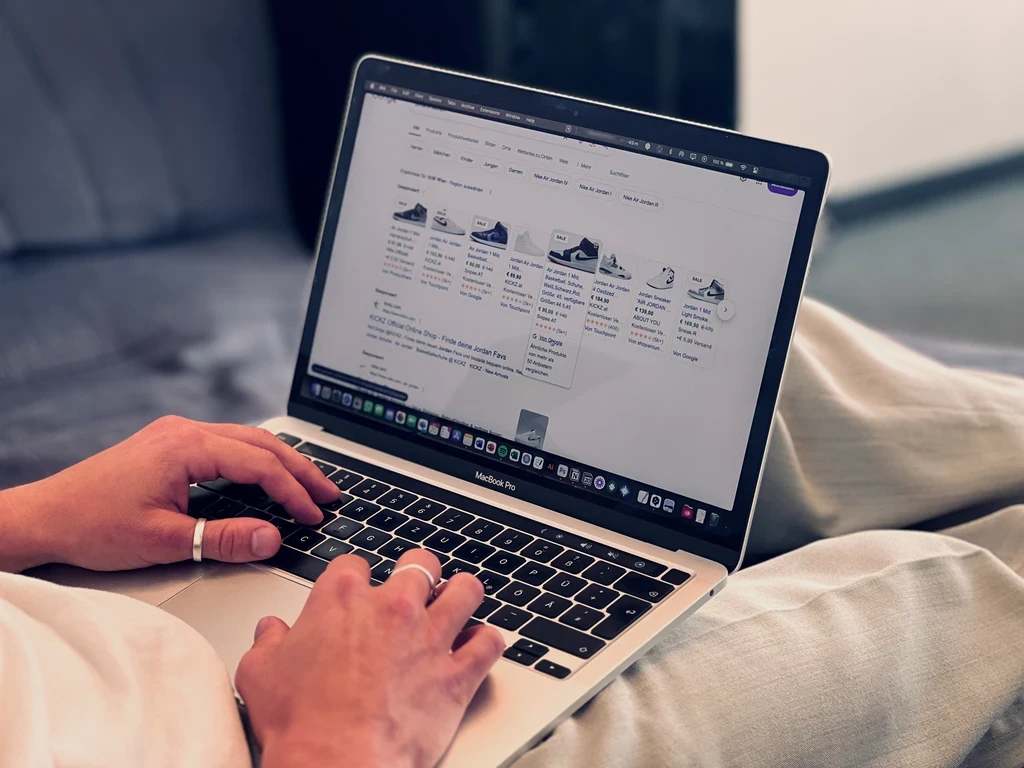
Wool search terms are more fiercely contested on Google Shopping than you might think for a niche: large haberdashery companies, marketplaces, international providers. Anyone who wants to stand out here is fighting not just for placement, but for recognition. This is decided on just a few square centimetres of tile.
Product image, price and title are often virtually identical for comparable yarns. The CSS line, on the other hand, is an element that can stand out from the crowd. As long as there was a third-party or generic name there, Filati wasted exactly this leverage while paying the full CPCs of the standard setup.
The turning point: „we love wool"
Together with Label Up, Filati set up its own Keyword CSS. The name was quickly found: „we love wool" is a statement that the target group takes literally. Anyone looking for wool reads a sentence under the ad that they would sign themselves.
Four concrete advantages – why this pays off for Filati
Own domain
The CSS runs on its own domain - not on the infrastructure of a third-party provider. This means: no dependence on external conditions, contract terms or platform decisions, and full sovereignty over its own comparison site and its data.Own name under every ad
Instead of a third-party provider, "By we love wool" is now under every product. In every search, in every tile. The slogan is present exactly where the buying decision is made: in the shopping result itself, thousands of times a day.It visibly sets Filati apart
In the carousel, one tile looks like another. A thematically appropriate CSS name is the one element that Filati controls themselves – and that works in a community that responds to belonging and trust. „We love wool" does not read like a mandatory entry, but like an announcement. This exact recognition is worth more in a brand-loving niche than in any mass market.1.2% free clicks - the CSS finances itself
The underestimated part of the CSS line: It is clickable. Anyone who clicks on "By we love wool" under Filati lands on the page with their own products. And this click is free; Google doesn't charge a CPC for it. At Filati, around 1.2% of all clicks go to this exact link. Sound like a little? It isn't: these free clicks alone already cover the running costs of the CSS. Everything else (the up to 20% lower CPCs, the brand presence, the differentiation in the carousel) comes on top from day one. The Keyword CSS is therefore not a cost item, but pays for itself.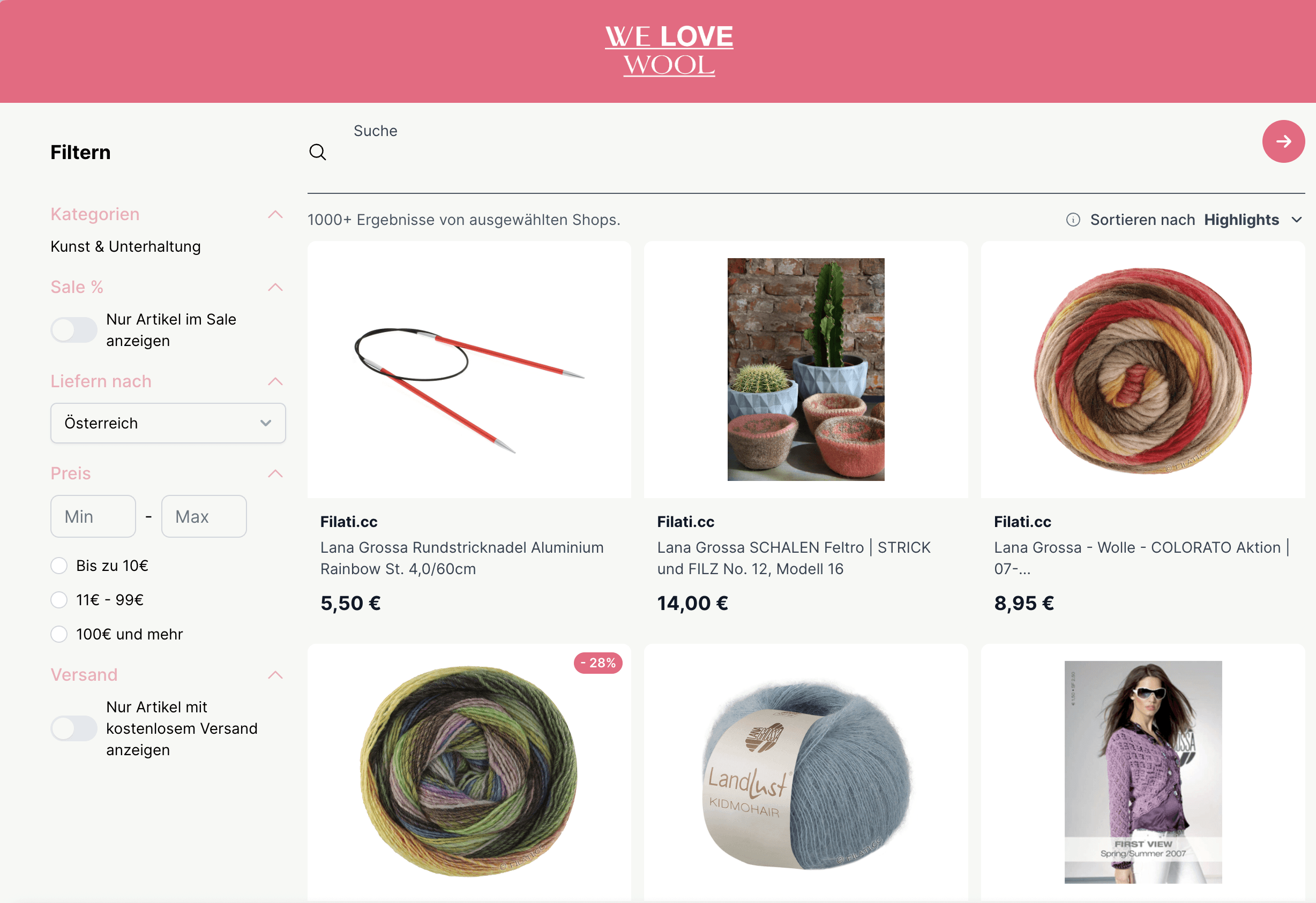
The implementation: no migration, no risk
The most common worry when switching CSS: "What happens to my campaigns?" The short answer: nothing that hurts. Merchant Center, feed and Google Ads campaigns remain in place. The CSS assignment is changed, not the setup. Campaign history, optimisations and Smart Bidding data are preserved. Label Up takes care of set-up and transition; there is virtually no technical effort on the shop side. As with all Keyword CSS, the transition at Filati went smoothly without interrupting live campaigns.
Also important: The whole thing is fully Google-compliant. External CSS are explicitly intended by Google, and the requirements for a compliant CSS are met by Label Up's setup as standard.
The result
An interchangeable entry in the shopping carousel has turned into a brand presence that supports itself: 1.2% free clicks cover the CSS costs, the lower effective click prices and the branding effect are pure gain. The CSS line now works for Filati instead of a third party. And the niche shop also uses its greatest strength where it was previously invisible: in the search result itself.

“Finally, our ads feature a name that actually fits us and not someone else's. This is also reflected in the domain. The fact that the CSS pays for itself through the free clicks was the argument that ultimately convinced us. For me, there is therefore really no reason not to use Keyword CSS – a genuine win-win for everyone.”
Kevin Blaschek
Head of Marketing @Filati
Conclusion: A niche is an advantage – if you make it visible
Shops with a clear niche and a loyal community in particular benefit the most from having their own Keyword CSS. Their greatest asset is their brand. And a Keyword CSS puts it right where it was previously missing: under every shopping ad, into every purchasing decision. And as the free clicks already cover the costs, the question is no longer whether the step is worth it, but only why the CSS line was actually working for someone else for so long. Filati took the step. Today, the "we love wool" CSS is no longer a technical detail, but part of the brand stage.
About

Filati is the online shop specialist for wool and yarn from LANA GROSSA. The family-run business (FILATI eCommerce GmbH) with locations in Wegscheid (Bavaria) and Altenfelden (Upper Austria) has been supplying knitting and crochet enthusiasts with the complete Lana Grossa collections, FILATI magazines, instructions, and original accessories for almost three decades. Tens of thousands of positive customer reviews testify to one of the most loyal communities in handicraft e-commerce.

Other topics