>

>

Google Shopping CSS: What online shops should not miss

Google Shopping CSS: What online shops should not miss

The Google CSS partnership enables agencies and online shops to operate their own price comparison sites and run shopping ads in their name. This not only reduces cost-per-click but also significantly increases brand visibility.
Colourful "shopping" air mattress that floats on the sea

In the world of online marketing, Google Shopping has become an indispensable tool for placing products directly in front of potential customers. However, since the introduction of Google CSS (Comparison Shopping Service), some things have changed. But what exactly is Google CSS, and why should your shop use this service to remain competitive? In this article, we will take a look at the background, functionality, and advantages of Google CSS.

What is Google Shopping CSS and why was it introduced?

Google CSS stands for "Comparison Shopping Service", a price comparison service that Google had to implement following a decision by the European Union. In 2017, the EU imposed a fine of 2.4 billion euros on Google, as the company was said to have abused its market power to disadvantage competition. The EU argued that users were more likely to click on the prominently displayed product images in the Google Shopping results, while competing price comparison services received little visibility.

In response, Google established Google Shopping Europe (GSE), an independent company within the Google group. The GSE was to ensure that external price comparison services receive equal conditions and can also display their offers on Google's search results pages. In theory, various price comparison sites compete within the Google Shopping system in the algorithms. One of these is Google Shopping Europe, while the others are the Google CSS participants.

How does Google Shopping CSS work in practice?

Google CSS allows price comparison services to participate in Google Shopping auctions. The bids from Google Shopping Europe include a margin that GSE takes from the click price. External providers pay no margin and bid at the full click price. Therefore, bids from CSS providers can include a lower CPC.

A practical example: If you bid a click price of €1.00 through Google Shopping, this amount could be reduced to €0.80 by using a CSS service, without affecting your ad position. This offers enormous cost efficiency and can make the crucial difference in the competition for the best ad placements.
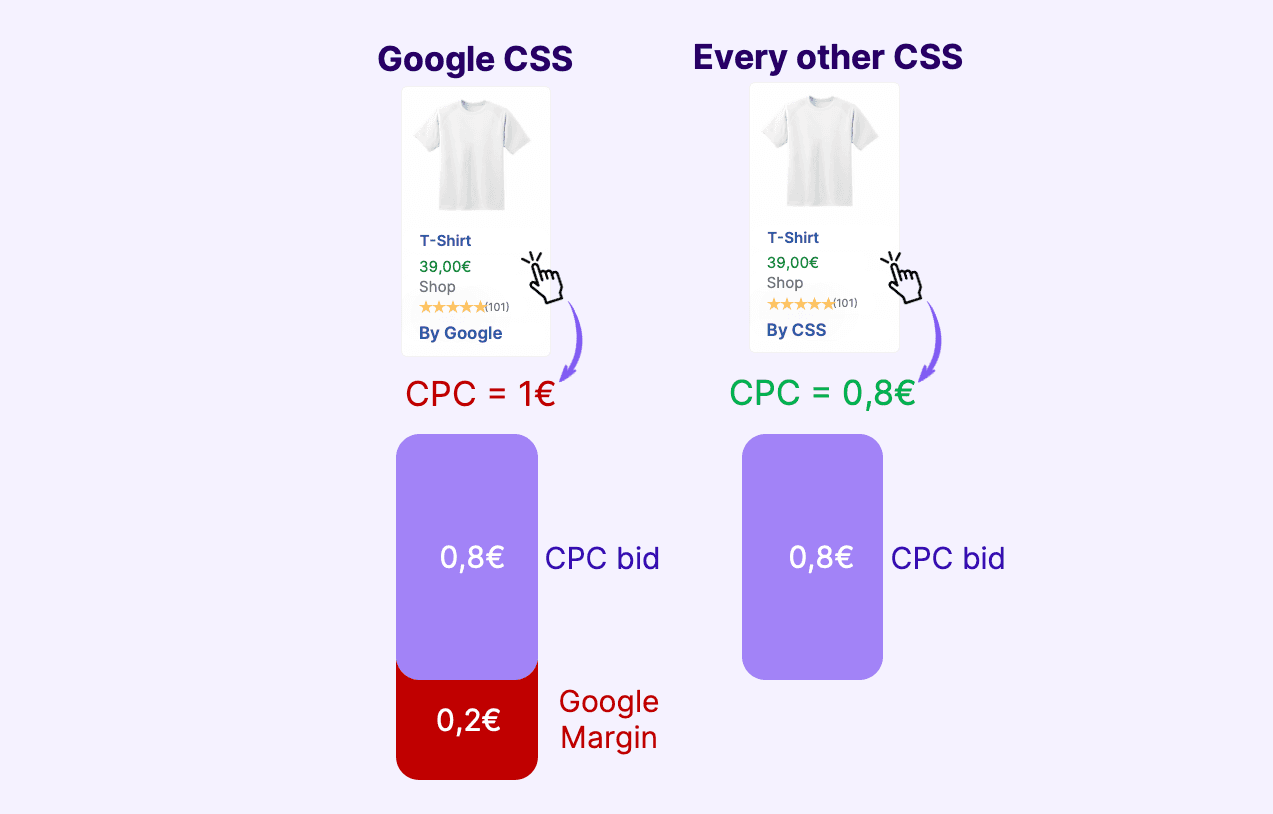
Margin Difference between the Google CSS and every other CSS

Why is Google Shopping CSS essential for your shops?

In today’s competitive environment in e-commerce, it is not just about being present but also about working efficiently. By using a CSS service, you can strategically optimize your bids and ensure that your ads remain visible for relevant searches, without incurring unnecessarily high costs.

Without a Google Shopping CSS solution, you risk falling behind in the competition for the best ad placements. While other retailers can reduce their CPCs through CSS, you would still have to pay the full price, which could significantly impact your profit margin.

Which Google Shopping CSS solution is right for you?

There are many CSS providers on the market, and the choice of the right service depends on several factors. On one hand, you might opt for an established third-party provider that already has a broad base of customers in its price comparison site.

However, if you are not only concerned with mere participation but also with strengthening your own brand and controlling your campaigns, a whitelabel CSS solution could be exactly what you need. Label up, for instance, offers a tailored Shopping CSS platform that allows agencies and online shops to promote their own brand while still benefiting from all the advantages of a CSS service. With such a solution, you retain full control over the bidding strategy and can activate all advantages for your own customers or shops without strengthening a third-party CSS brand.

Conclusion

Google CSS has changed the landscape of online marketing and offers merchants a valuable opportunity to lower their costs while remaining competitive. Choosing the right CSS provider is crucial to maximizing the benefits from your Google Shopping campaigns. Whether you choose an established third-party provider or prefer the control and flexibility of a whitelabel solution like Label Up – it is important that you take the step towards a CSS service to remain competitive in the long term.

About

Label Up is a tech provider from Vienna that helps agencies and shops achieve better results with its own Google Shopping CSS and smart label-based optimization.

Featured Posts

20 May 2026

/

3

Min reading time

With the Loyalty Add-On in Google Merchant Centre, you can show your loyal customers directly in ads which member benefits they receive. In this article, you’ll learn everything about the setup in Merchant Centre and how Label Up can help you with it.

Ready to Label Up?

Questions about the Google CSS partnership? Or would you like to learn more about optimisation with smart labels? Regardless, you can discuss with one of our experts. In a short online call, we can show you our solution and discuss your questions. All without sales talk.

Filip

Co-Founder & Partnerships

Ready to Label Up?

Questions about the Google CSS partnership? Or would you like to learn more about optimisation with smart labels? Regardless, you can discuss with one of our experts. In a short online call, we can show you our solution and discuss your questions. All without sales talk.

Filip

Co-Founder & Partnerships

Ready to Label Up?

Questions about the Google CSS partnership? Or would you like to learn more about optimisation with smart labels? Regardless, you can discuss with one of our experts. In a short online call, we can show you our solution and discuss your questions. All without sales talk.

Filip

Co-Founder & Partnerships

Read more:

15 Jul 2026

/

3

Min reading time

Can you use multiple Google Merchant Centers at the same time? Do bids cannibalise each other in a multiple Google CSS strategy? Do you pay double CPC with multiple CSSs? This concern keeps many e-commerce decision-makers from implementing multi-CSS setups. However, the fear of outbidding yourself is unfounded. This article explains how the Google Shopping auction works technically, why your website domain protects you and how you can use the double CSS strategy as leverage for greater reach.

26 Jun 2026

/

3

Min reading time

FIRST STARS has been using Label Up for over a year, gaining not only increased visibility at lower prices, but also massive advantages in customer loyalty.

3 Jun 2026

/

3

Min reading time

Effective segmentation opens the black box of Google Pmax. Instead of blindly trusting Google's automation, you control your campaigns using multidimensional data. This guide shows you how to combine performance data, product data and market prices. Discover why classic templates are not enough and how to use Label Up's Labelizer to make real predictions to allocate your budget profitably.

20 May 2026

/

3

Min reading time

With the Loyalty Add-On in Google Merchant Centre, you can show your loyal customers directly in ads which member benefits they receive. In this article, you’ll learn everything about the setup in Merchant Centre and how Label Up can help you with it.

15 May 2026

/

3

Min reading time

For 1.5 years, Sichtbar Online Marketing AG has been using Label Up’s white-label CSS. Jonas Jakobs, CEO, explains how switching to Label Up delivered the decisive boost in performance. While the potential of Google Shopping had often gone untapped before, the agency now offers its clients maximum efficiency and exclusive branding with its own white-label CSS solution, at no extra cost. A real no-brainer for Google Ads agencies.

8 Apr 2026

/

3

Min reading time

In the competitive e-commerce environment, a simple product image is often no longer enough to capture users’ attention. Google Shopping Lifestyle Images offer the solution here: with this new feature, you can present products in a natural, emotional setting. This not only increases the click-through rate, but also provides the AI behind PMAX with valuable data to serve your ads more relevantly. That way, you can use lifestyle images without risking policy violations.

15 Jul 2026

/

3

Min reading time

Can you use multiple Google Merchant Centers at the same time? Do bids cannibalise each other in a multiple Google CSS strategy? Do you pay double CPC with multiple CSSs? This concern keeps many e-commerce decision-makers from implementing multi-CSS setups. However, the fear of outbidding yourself is unfounded. This article explains how the Google Shopping auction works technically, why your website domain protects you and how you can use the double CSS strategy as leverage for greater reach.

26 Jun 2026

/

3

Min reading time

FIRST STARS has been using Label Up for over a year, gaining not only increased visibility at lower prices, but also massive advantages in customer loyalty.

3 Jun 2026

/

3

Min reading time

Effective segmentation opens the black box of Google Pmax. Instead of blindly trusting Google's automation, you control your campaigns using multidimensional data. This guide shows you how to combine performance data, product data and market prices. Discover why classic templates are not enough and how to use Label Up's Labelizer to make real predictions to allocate your budget profitably.

20 May 2026

/

3

Min reading time

With the Loyalty Add-On in Google Merchant Centre, you can show your loyal customers directly in ads which member benefits they receive. In this article, you’ll learn everything about the setup in Merchant Centre and how Label Up can help you with it.