Google CSS Requirements: What You Need to Fulfill as a Partner
Becoming a Google CSS Partner offers agencies and shops clear advantages: lower CPCs, higher performance, and full branding. With Label Up's white-label solution, you meet all Google requirements, from price comparison sites to verification: fast, scalable, and stress-free.

As a retailer on Google Shopping or as a performance marketing agency in online marketing and Google Ads, participating in the Google CSS (Comparison Shopping Service) program is a significant advantage. The CSS partnership can not only increase your customers' visibility on Google Shopping but also significantly improve the efficiency and ROI of your campaigns. In this article, you will learn step by step how to become a Google CSS partner without relying on a third-party CSS – and why the price comparison toolkit from Label Up makes this process much easier for you.
Overview: What is Google CSS?
Before you embark on the path to Google CSS participation, you should know exactly what the Google Comparison Shopping Service (CSS) actually is. A CSS is a price comparison portal that allows retailers & e-commerce platforms to advertise their products on Google Shopping and PMAX. These services provide consumers with the ability to compare products and prices from various providers clearly on Google.
If you operate your own price comparison portal as an agency and appear as a Google CSS partner, your customers' shopping ads will display with the name of your CSS. Your own name under the shopping ad? – that gives you more control, visibility, and better conditions with Google Support.
The Requirements for Your Own Google CSS
To be recognized as a CSS partner by Google, you must meet certain conditions. Central to this is the operation of an independent and functional price comparison platform that complies with Google’s guidelines.
The most important criteria from Google are:
at least 50 merchants per country in your portfolio to compare
clear presentation of the products including name, price, and image
linking each product to the respective shop, so that users can purchase directly
at least two filtering options to sort the products sensibly (e.g. by price, brand, category)
If you want to build your own price comparison site - without relying on a white label solution like Label Up - technical know-how is essential. Your agency should have the knowledge and resources to continuously operate and optimize the website.
All Requirements for a Google CSS Partnership at a Glance:
Google CSS Requirement | Explanation | Support from Label Up |
own price comparison site | basic prerequisite for Google Shopping Ads | Label Up provides a fully Google-compliant price comparison site (white label). |
product presentation | clear product presentation | The data from your MC is seamlessly integrated. |
direct link to the correct shop | every click on the product must lead directly to the shop | Fully automated & GDPR-compliant setup. |
at least 50 merchant centers per country | The rule ensures that your CSS is a real comparison service | Label Up adds the 50 shops so you meet the requirements. |
at least 2 filter options | criterion from Google for every CSS | The Label Up price comparison site comes standard with filter options. |
technical infrastructure | CSS center, MC, website, and ads are closely interconnected | Label Up introduces you to the infrastructure and takes care of the creation of CSS center and MC. |
technical know-how | an own CSS requires a lot of technical knowledge | The Label Up team consists of experts who assist you and take on these tasks. |
current data | regular feed updates | Label Up takes care of the updates |
comply with CSS guidelines | all requirements must be met | Label Up websites meet all Google guidelines and set up the site for you. |
accessibility | CSS must be publicly accessible | Label Up CSS are user-friendly and suitable for your CI |
Google verification | Google verifies the CSS | Label Up guides you through the process and ensures the verification. |
The Technical Infrastructure of a Google CSS Partner
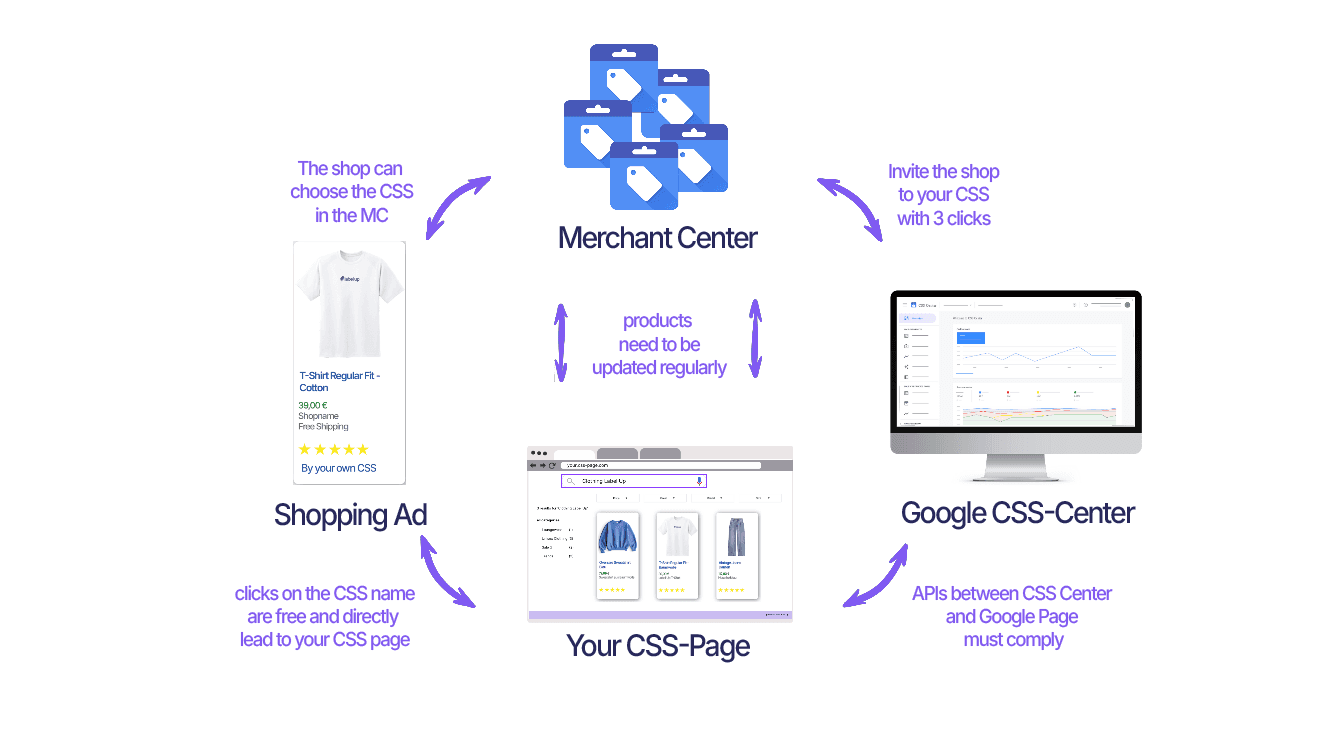
The technical infrastructure of a Google CSS partner consists of four main components, whose interplay ensures flawless performance.
To ensure your own CSS functions properly, four central components must interact:
Google CSS Center: Here, you manage all connected merchant accounts, activities, and settings. Through your CSS Center, you can invite shops to your price comparison portal in just three clicks. Access to the Google CSS Center is provided by Google once you are accepted into the CSS program.
Merchant Center: Merchants select your CSS here. Product data must be updated regularly – manually or via automated feeds.
Your CSS Website (Landing Page): It presents products clearly with price, image, and direct linking to the respective shop. Technical interfaces (APIs) must be set up and maintained between the CSS Center and landing page.
Shopping Ads on Google: Once your CSS is actively selected, the CSS name appears below your customers' shopping ads. When a user clicks on it, they are taken directly to your CSS page free of charge.
💡 Tip: With the CSS white label solution like Label Up, this entire process – including API maintenance, updates, and domain integration – is automated for you.
Own Google CSS without 50 Merchant Centers - How Do I Still Meet the Requirements?
Google requires that you have at least 50 Merchant Centers in your portfolio for CSS partnership. This is a significant hurdle, especially for smaller agencies, freelancers, or startups. Here, the white label software from Label Up offers you a clever solution. Our price comparison platform is Google-certified and meets all the requirements. Even if you manage less than 50 Merchant Centers, you can have your customers "pyed up" through Label Up. This way, you meet the conditions without having to build a complex infrastructure yourself. You also don’t have to worry about verification with Google when working with Label Up.
Meet All Requirements for Google CSS with Label Up
Building your own CSS is tempting, but fulfilling all the requirements involves significant effort.
If you are looking for a template for a price comparison site that you can fill with your own logo and your customers, you are in the right place at Label Up. This way, you benefit from:
A fully functional, Google-compliant price comparison platform
Automatic integration of all your customers' products into your CSS
Easy management and verification with Google
Your own branding and domain presence
Technical support and ongoing maintenance
This means: You can fully focus on your core competencies – while taking advantage of all the benefits of being a Google CSS partner.
Conclusion - Meeting All Requirements for Your Own Google CSS
The Google CSS partnership is a powerful tool to enhance the performance of your shopping and PMAX campaigns and make your customers more visible. However, building your own price comparison platform with at least 50 Merchant Centers is demanding. If you currently have fewer merchants or don't want to manage the technical infrastructure yourself, the white label CSS software from Label Up is the best solution for you. It combines the advantages of having your own CSS with minimal effort – giving your agency a real competitive advantage.
About

Label Up is a tech provider from Vienna that helps agencies and shops achieve better results with its own Google Shopping CSS and smart label-based optimization.

Other topics